Permit me to engage you in the story of a woman who began her journey on a very unlucky note wanting nothing to do with a God who seemed to have allowed far too much pain into her life. One of the things I have carried with me long after embracing this story is the beauty of finding purpose in pain not as a cliché stitched onto a difficult season to make it more bearable, but as something Jesus Himself modelled.
There is a kind of faith you cannot manufacture in a comfortable pew. You cannot sing it into being on a good Sunday morning, and you certainly cannot arrive at it by reading only the parts of Scripture that make sense of a life that is going well. That kind of faith is forged somewhere else entirely; in solemn hospital corridors, in the silence that follows a child's last breath, in the wreckage of a marriage that was supposed to last forever, in a body that seems to be at war with itself. That is the faith Vaneetha Risner writes from in The Scars That Have Shaped Me, and it is not a faith that fits neatly into the narratives many of us have been handed about what it means to believe an.
Permit me to engage you in the story of a woman who began her journey on a very unlucky note wanting nothing to do with a God who seemed to have allowed far too much pain into her life. Polio as an infant. Numerous surgeries that reshaped her body and her childhood. The cruelty of being bullied for the way she walked. The devastating loss of a son. A marriage that collapsed under its own weight. And then, much later, the humbling discovery of just how debilitating certain seasons of her own body and mind could be. If you were reading her story from the outside, you would be forgiven for concluding that God was simply absent from it… that He had either forgotten her or never noticed her in the first place.
But here is what struck me most as I sat with her story: the remarkable thing isn't that she survived all of that. Plenty of people do survive, or at least try to. What is remarkable is that she stopped merely surviving and started actively looking for God in the very places she had once written Him off. That is not a small shift. That is the difference between enduring a life and inhabiting one.
One of the things I have carried with me long after embracing this story is the beauty of finding purpose in pain not as a cliché stitched onto a difficult season to make it more bearable, but as something Jesus Himself modelled. We see the story from John chapter 9, of a man born blind. The disciples, standing before this man, ask Jesus the question that so many of us are tempted to ask when we encounter suffering: "Who sinned, this man or his parents, that he was born blind?" It is a question that searches for a cause or someone to blame so that the universe still makes moral sense. But they got a surprise in the response that is still relevant today. Jesus reveals a much deeper reason to the man’s predicament, that “the works of God might be displayed in him.”
It may sound as if God was unjust for causing this man to suffer all throughout his life just to make a statement, but a closer look at this statement causes us to see that rather than provide an avenue for complaint, He rather gave the man’s pain a direction. He neither did not pretend that the man’s years of struggle didn’t matter. Once I understood that this was the lens throughwhich Risner learned to see her own losses, her story stopped reading like a tragedy and started reading like a testimony still being written.
It compelled me to ask myself a solemn question, “how often do I approach my own hard seasons demanding a cause, when what I actually need is to ask God for a purpose?"
Another thing I learned from Vaneetha's life is the staying power scars have and I mean that both literally and in every other sense the word carries. For years, hers was hidden, ashamed of the visible reminders of polio and of surgery, of the narrative about her body and her story. But an encounter with the scars of the resurrected Christ reminded her that she’s not alone and that was enough for her. After Jesus resurrected, He could have chosen to erase the scars but he kept them, because it reminded Him and all who encountered Him of the pain He had to carry for the redemption of us all. It reminds me of a phrase a close friend of mine says, that scars are beautiful, and Jesus and Vaneetha’s life are evidence of this truth.
And oh, this changed something in me too. Both physically and emotionally. I have a scar I have been hiding too. I told myself I will get rid of it as soon as I get money. But now, I wear it with pride, because it reminds me that it is in the forge of pain that faith is refined. A scar is not only evidence of damage. It is proof of healing and survival. I think many of us, myself included, spend a great deal of energy hiding the marks that life has left on us, when those very marks might be the clearest evidence we have of God's faithfulness in the middle of our hardest chapters.
I could not read Vaneetha's story purely as a box to tick, because so much of what she models is, at its core, a leadership posture. Leadership, especially the kind we are being formed for in this fellowship, is built in the very places she describes, in setbacks that were not part of the plan, in seasons where the outcome you prayed for did not arrive, in the slow and often invisible work of choosing integrity and trust when no one is watching and nothing is resolved yet.
Every leader I admire has a story of loss or failure tucked behind the composure. What separates leaders who go on to shape others from those who quietly burn out is rarely the absence of pain, but what they do with it: whether they hide it as though it disqualifies them, or let it become part of the credibility of their voice. People do not follow leaders because those leaders never struggled. They follow leaders whose scars tell them, I have been where you are, and there is a way through.
In all that I have shared, there are questions I want to believe are already forming in your mind.
And if they aren’t then I will help you out.
Where am I hiding scars instead of letting them tell God's story?
Where have I allowed unanswered prayers to slowly calcify into unanswered doubts?
Life does not offer a formula. It does not promise that if you trust God enough, the polio will not come, the marriage will not fail, the child will not be lost. What it lays down instead is something sturdier than a formula, that God meets us in the darkest chapters of our lives and not only in the bright ones. That He is not simply the God of the mountaintop testimony but the God who sits with us in hospital rooms and in the silence after loss, quietly writing purpose into predicaments we would never have chosen.
I do not know what chapter you are in as you read this. But I do know that whatever scars you are carrying, visible or hidden, physical or otherwise — they do not have to be evidence that God has forgotten you. They can, if you let them, become proof that He never left.
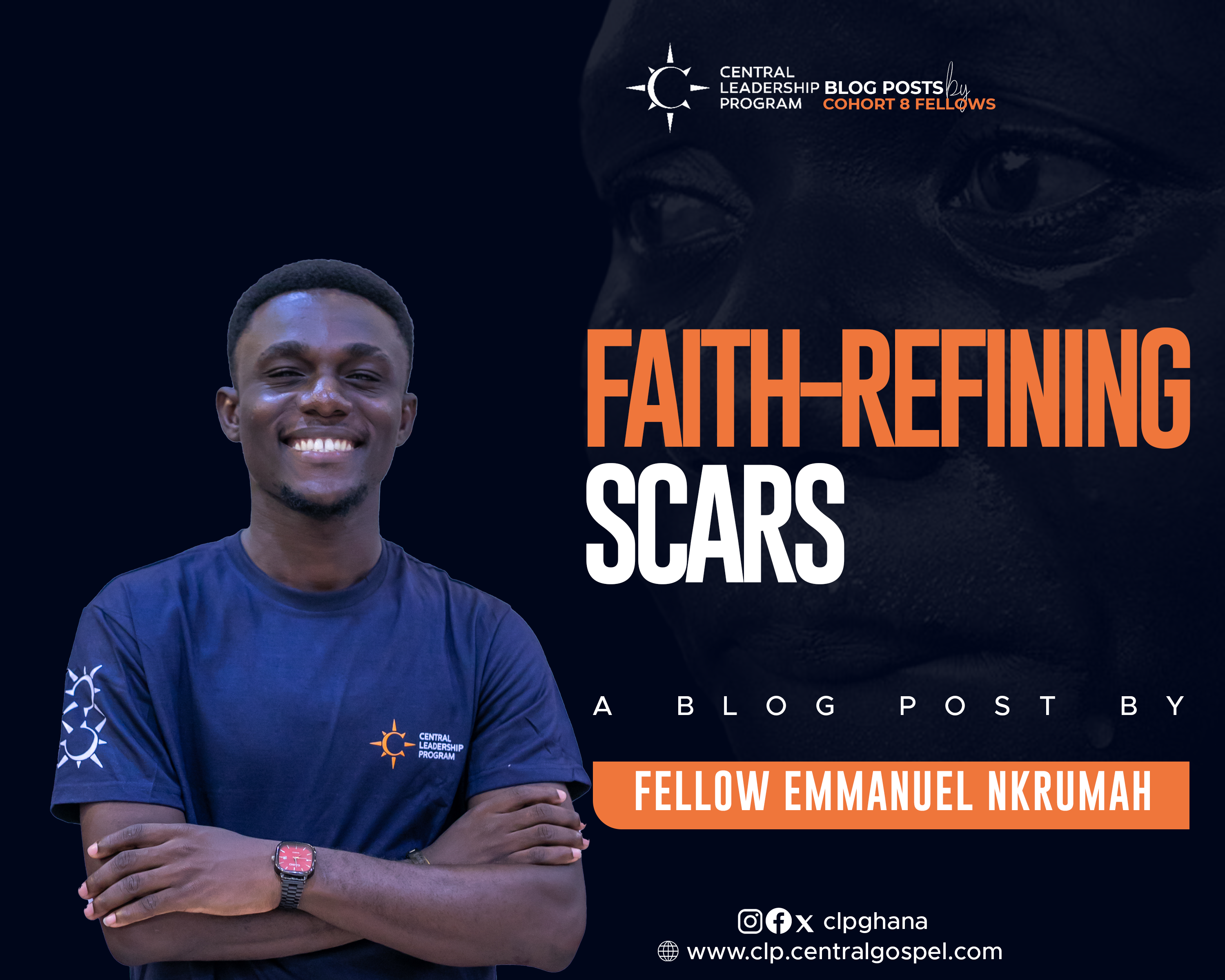
By Fellow Emmanuel Nkrumah