We are not waiting for Africa's story to be told. We are the ones telling it, one decision, one action, one act of excellence at a time.
When You Lead, Africa Leads With You
Realizing that your life is already showing others what Africa is changes everything. I learned that leadership is not a chair you occupy, but a mirror you carry. It is not about a title or an office. It is about reflection. And for those of us who call this continent home, that mirror does not just reflect us, it reflects Africa.
Leadership Beyond the Podium
For a long time, I thought leadership belonged to Presidents, Chiefs, and the bold names in history textbooks. Big titles, big offices and portraits on the wall. I have learned that leadership often begins in quiet, unseen moments: picking up litter you didn't drop, arriving early when no one is keeping count, keeping a promise when breaking it would have been easier.
Each of Us Is a Small Africa
This is what changed how I see myself. Every African alive today is a living representative of this continent. Not as a metaphor, but literally. When a Nigerian student excels abroad, people don't just say "she is brilliant," they say "Africans are brilliant." When a Ghanaian entrepreneur builds something remarkable, it doesn't end as his personal story, it becomes a story about African innovation. We do not have the luxury of succeeding or failing alone. Whether we want it or not, our individual stories are woven into a collective narrative.
This is both a burden and a privilege. A burden because stereotypes are heavy and unfair. One person's mistake can be twisted into false proof that an entire continent has failed. A privilege because it means your discipline, your integrity, your excellence, however small they feel, are quietly rewriting the story of over a billion people.
Chinua Achebe captured it simply: until the lions have their own historians, the hunter will always be the hero of the story. If we do not lead the narrative about ourselves, someone else will and they will not be kind with the details. This is what I mean when I say African leadership is communal before it is personal.
Ubuntu, the Southern African philosophy that says "I am because we are," explains it best. Leadership here is not about standing above the crowd; it is about standing accountable to the crowd. Wangari Maathai, who planted a movement one tree at a time, understood this. She did not wait for a title to begin restoring her country's land, she picked up a seedling and started.
The Weight and the Wonder of Representation
I think about this every time I enter a room, an interview, or a leadership forum. I am not just a student. I am, in that moment, a small sample size of what an African young person can be. That thought used to intimidate me. Now it disciplines me.
Nelson Mandela said it best: it always seems impossible until it is done. Every generation of African leaders, from the independence era to today's tech founders, has had to walk into rooms where both the odds and the opinions were stacked against them and do the impossible anyway.
We are not waiting for Africa's story to be told. We are the ones telling it, one decision, one action, one act of excellence at a time. For too long, the story of leadership in Africa has been written by outsiders. A story of crisis, of absence, of failure. A story that treats leadership on the continent as a problem to be managed, rather than a people writing their own future.
Leadership Is Rarely Loud
We often picture leadership as a person at a podium, a title on a door, a decision from the top. But most of the leadership that actually shapes Africa's story happens without an audience. It happens in the discipline of showing up when no one is watching, in the consistency of doing unglamorous work long enough for it to matter and in the integrity of doing what is right even when it costs you.
Discipline, integrity, consistency, and excellence may sound old-fashioned next to buzzwords like vision and innovation. Yet they are the quiet foundation beneath every visible achievement. A vision without discipline is just a wish. A strategy without consistency is a false start. Africa is not short of ideas. What determines whether the future arrives is whether enough people are willing to do the small, repeated, unglamorous work of building it.
What the Ground Actually Teaches
There is a type of leadership education that no classroom can fully teach. The kind you get when you are handed real responsibility before you feel ready. And that work rarely looks like the leadership Africa is shown to practice in global media. It is not a TED Talk; it is a to-do list. But it is real, it is everywhere, and it is the actual material from which the continent's future is being built.
Rewriting Who Gets to Lead
To understand Africa's leadership story honestly, we must also notice who has been left out of it especially young people. Programs that deliberately develop young leaders, cohort by cohort, over months rather than in a single workshop, matter because they treat leadership as a skill that is built, not a trait you are simply born with. Being part of such a cohort is itself a small act of rewriting the narrative. It says leadership development is not something young people must wait for permission to receive from outside, it is something they can build for each other, deliberately, right now.
The Real Story
The real narrative of leadership in Africa is not about catching up to somewhere else. It is about people refusing to wait for someone else to come and fix things, deciding instead to stand up, and trusting that consistency practiced long enough, in enough rooms, by enough people becomes transformation.
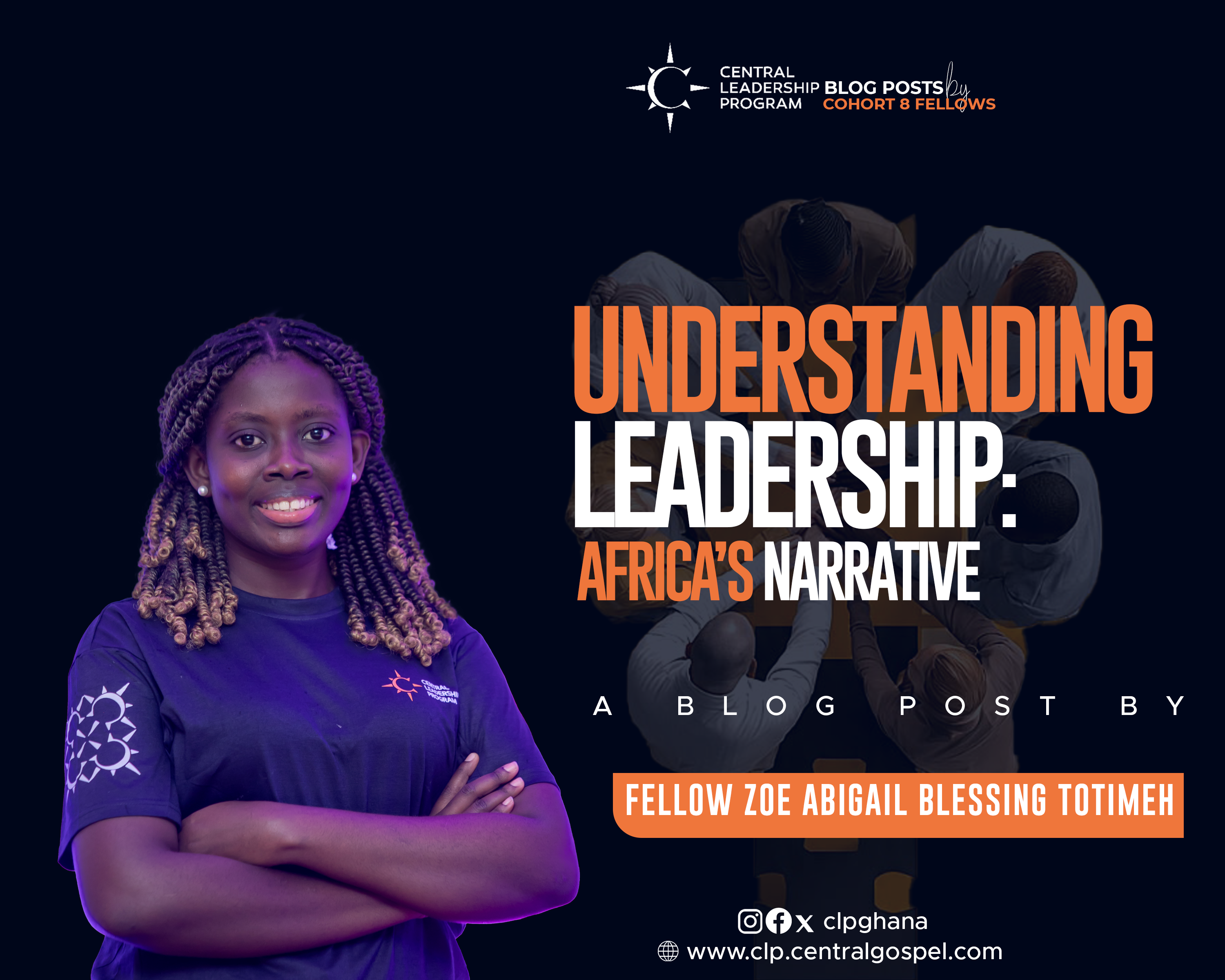
Written by fellow Zoë Totimeh